
Reverse-engineering a successful WordPress plugin means running it through the full competitor scorecard, isolating the one signal it's strongest on, mapping that signal to what its positioning actually promises, and then checking whether the gap between the two is something you could realistically close.
This is the procedural follow-up to asking what a successful plugin can teach you. That earlier piece is three open questions and a qualitative read - useful for deciding whether a plugin is worth this deeper look at all. Once you've asked those questions and picked a candidate, this is the actual four-step teardown: hands-on, numbered, and built on a completed scorecard rather than open judgment.
This also assumes you've already got the 11-signal scorecard filled in for the plugin. If you haven't, start there - this process is what to do with a completed one, not how to build one.
Open StatWP, head to the plugins search (or the themes search, if the competitor you're studying makes a theme instead), and pull up the competitor by name - their overview card carries the same eleven fields the four steps below walk through, real numbers instead of a guess from memory.
Pull Up a Competitor's Scorecard
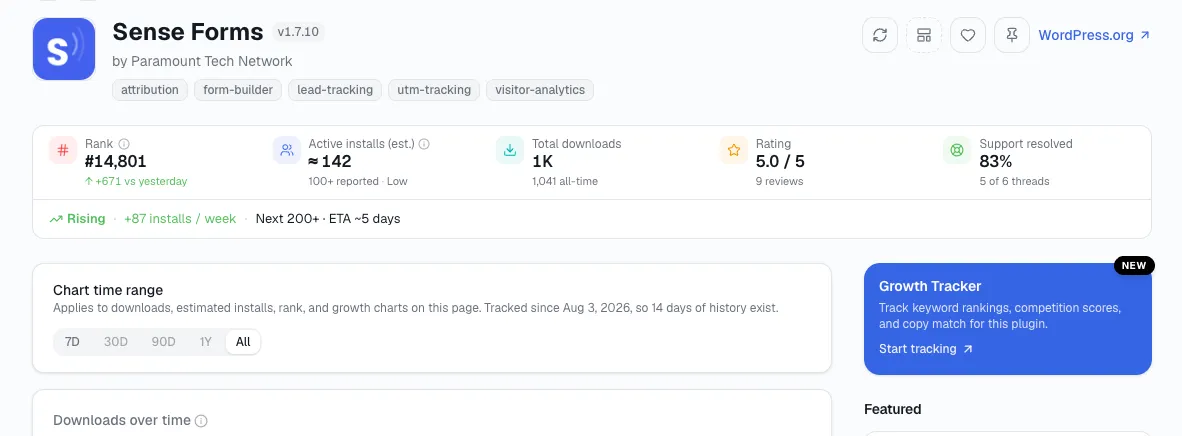
In brief: To reverse-engineer a successful WordPress plugin, run it through the full competitor scorecard, isolate the one signal it's strongest on, map that signal to what its positioning promises, and check whether you could realistically close that gap.
1. Rank its own eleven signals against each other
Not against a competitor - against itself. Which of its own signals is furthest above where you'd expect for a plugin of its install size? A plugin with unremarkable installs but unusually strong release activity and a fast-moving version distribution is winning on execution speed, not reach. A plugin with huge installs but flat growth and a stale changelog is coasting on being first to market, not on current strength. Those are different plugins to compete against.
Write the eleven signals down in a column and mark each one relative to what you'd expect for a plugin that size - well above, roughly expected, or below. What I've noticed: most plugins show two or three signals clearly above the line and the rest sitting near expected. That short list of above-the-line signals is what you carry into the next step.
2. Isolate the one signal doing the real work
Most successful plugins aren't strong across all eleven signals - they're strong on one or two and merely adequate on the rest. Find that one signal. I've found it's usually the actual reason a user picks this plugin over an equally competent alternative, even if it's never stated directly anywhere in their marketing.
If step one left you with two or three above-the-line signals instead of one clear standout, look at which of them is hardest for a competitor to copy quickly. Release activity and support speed are operational - a competitor could match them with enough consistent effort. A large existing install base isn't something a new entrant can replicate on any reasonable timeline. When in doubt, the harder-to-copy signal is usually the one actually doing the work.
3. Map that signal to their stated positioning
Read their listing and marketing copy again, now specifically looking for whether they talk about the signal you just isolated. Sometimes a plugin's real strength and its marketed strength are the same thing. Sometimes they're not - a plugin might be winning on release cadence and reliability while marketing itself on feature breadth, which tells you their users are staying for a reason the plugin itself doesn't seem to fully realize.
My read on this: a mismatch here is actually the more useful outcome, not a dead end. If a plugin is winning on reliability but marketing feature breadth, a competitor who leads with reliability directly is speaking to the actual reason people stay - something this plugin isn't even claiming for itself.
Their reviews are a second, complementary way to check this same mismatch - what a competitor's positioning avoids saying often shows up directly in what their own users complain about. Turning a plugin's bad reviews into a feature idea is the worked deep dive on reading that signal specifically.
4. Decide whether that gap is one you can close
Whether it's closable depends on what kind of strength you're up against:
Structural strength - a large existing install base, a long-standing integration partnership. Harder to compete with directly.
Operational strength - fast support response, frequent small releases, a specific compatibility promise. Beatable with consistent execution, not a moat.
Here's the quick test I use to tell which kind I'm facing: does the strength depend on time already invested, or on a decision made this quarter? An install base took years to build and can't be shortcut. A faster support response time is a decision you could start making today - it just takes sustained follow-through to become believable.
A worked example of how the four steps chain together
Here's an example I use to show how the four steps chain together. Say a competitor shows unremarkable installs but release activity well above what you'd expect for its size, and a version distribution where most of its users are already on the latest release. Step one flags release activity and version adoption as the two signals above the line. Step two isolates release activity as the harder-to-copy one, since fast version adoption is partly a downstream effect of shipping often and reliably. Step three checks their marketing - if they talk almost entirely about features and never mention how often they ship, that's a mismatch. Step four calls this an operational strength: beatable with a real, sustained release cadence of your own, not a moat built on years of install history.
Skip the guesswork - the numbers already live on StatWP
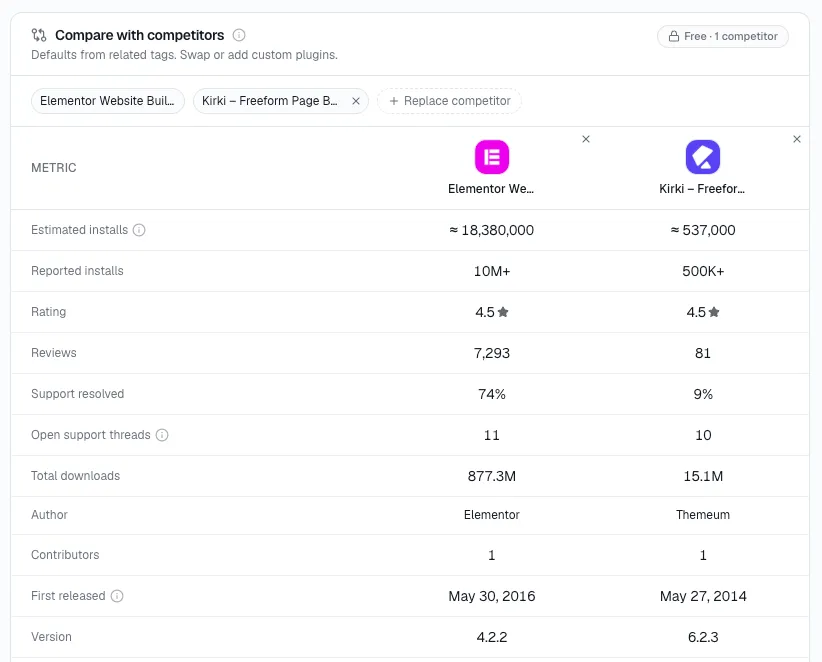
You've already seen where that scorecard lives on StatWP. Once you've isolated the signal worth targeting, pull a second competitor's numbers the same way, or line them up together on the compare tool.
Where this differs from just asking what a plugin teaches you
If you're deciding which of these two posts fits what you're trying to do right now, the split is simple:
Studying what a plugin can teach you is a mindset exercise - three open questions, applied by reading and judgment, no scorecard required to begin.
Reverse-engineering is this post - a fixed four-step process that starts from a completed scorecard and ends with a specific, closable-or-not gap.
Use the first when you're still deciding which competitor deserves the closer look. Use this one once you've already picked them and pulled their numbers.
A few things worth clarifying before you start
Do I need to reverse-engineer every competitor on my shortlist?
No - reverse-engineering is worth doing on the one or two names that clearly stand out after the diagnostic questions in the earlier post, not on every competitor you track. Running the full four-step process on the whole list defeats the point of narrowing it down first.
What if step one doesn't turn up a clear standout signal?
A competitor with no signal clearly above expected for its size is usually winning on structural strength alone - being first to market, or being the default choice - not a sign the reverse-engineering process failed. To me, that reads as a real finding worth knowing, even without a single sharp signal to isolate.
How often should I redo this for the same competitor?
Redo the reverse-engineering teardown after a major release or a pricing change on the competitor's side, or roughly once a quarter alongside a full scorecard refresh - the same cadence covered in tracking your competitors on a fixed schedule.
Does this process work if the competitor makes a theme instead of a plugin?
Yes - the same four-step reverse-engineering process works for a theme competitor: pull the same eleven signals from StatWP's theme overview card, then run through the same ranking, isolation, and positioning-match steps described above.