
Finding a market opportunity in an abandoned WordPress plugin means scanning for listings that combine a real install base with no meaningful update in roughly two years, then working out which of four things that specific plugin actually calls for - a fork, a direct replacement, a migration path for its users, or nothing, because plenty of abandoned plugins are abandoned for good reason.
This is a distinct opportunity type, not a niche-selection method like the other posts in this series. It's about one specific quiet plugin, not a category-wide read.
Roughly 59% of the plugins listed on WordPress.org fall into some version of this pattern - no update in over two years - according to WP Tavern's analysis of directory data. This tracks with a few other cases I've checked: most of that is genuinely irrelevant - low-install plugins nobody depends on. The opportunity, as I see it, is narrower: the plugins inside that 59% that still carry a meaningful install base despite going quiet.
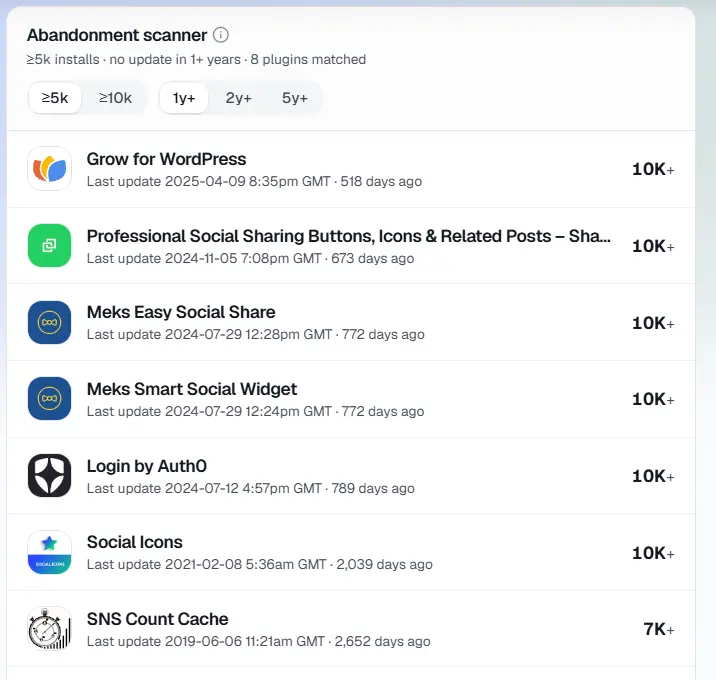
StatWP's abandonment scanner already flags exactly that combination - real installs, no recent update - inside any niche view, for plugins and themes alike.
Run these checks before you get excited
Check install base first: a stale plugin holding a few hundred installs isn't worth the same attention as one still holding tens of thousands.
Then check why it went quiet, as far as you can tell from the changelog and the author's other listings: a single-maintainer plugin whose author has gone quiet across all of their plugins reads differently than one plugin going stale while the same author actively maintains three others.
Then read the reviews and open support threads for what's actually broken. A plugin that still mostly works and has simply stopped receiving updates is a different opportunity than one accumulating compatibility complaints after recent WordPress core releases - the second is actively losing installs right now, which is more urgent and more visible to its own users.
Walking through one, start to finish
Here's what that three-step read actually looks like in practice, walked through against a hypothetical example - call it "Plugin Q," a stand-in for illustration, not a real listing:
Install check. Plugin Q shows roughly 30,000 active installs on its WordPress.org listing - well past the "a few hundred" threshold that would make it not worth the time. That clears the first check.
Why it went quiet. The changelog shows no update in 27 months. The author's profile lists two other plugins, both of which received updates within the last quarter - so this isn't a maintainer who's gone quiet everywhere, just on this one listing. I read that as a more promising sign than an author who's stopped maintaining everything at once, since it suggests the plugin itself was deprioritized rather than abandoned outright.
What's actually broken. The support forum's last dozen threads mostly report the plugin still working, with a couple of recent posts flagging a conflict with a common page builder update. Nothing catastrophic yet, but in my experience a compatibility issue is exactly the kind of complaint that gets worse as WordPress core and other plugins keep shipping updates around a listing that isn't.
On my read, Plugin Q clears the install-base bar, has a plausible non-catastrophic reason for going quiet, and is starting to show the early compatibility complaints that tend to compound. That combination - real installs, a maintainer who's active elsewhere, and a fixable-not-fatal complaint pattern - is closer to a fork or replacement candidate than a "do nothing" case, which is the call the next section walks through.
Four paths forward - including doing nothing
An abandoned plugin that clears those checks can point you toward one of four different moves:
Fork it. If the license and situation allow it, forking a well-used, cleanly built plugin that just lost its maintainer can be faster than building the same thing from nothing. I'd flag Plugin Q, with its maintainer still active elsewhere, as a case worth a direct outreach before forking - sometimes the fastest path is asking.
Build a direct replacement. If forking isn't practical, this is the more common path - aim it specifically at users who are about to go looking for one, since the compatibility complaints already showing up are the leading edge of exactly that group.
Build a migration tool. Sometimes the more useful move is helping a stale plugin's users move to whatever active alternative already exists, rather than becoming the alternative yourself.
Do nothing. Sometimes the honest answer is nothing - a plugin can be quiet because the problem it solved got absorbed into WordPress core or a page builder, which is a demand question, not an opportunity.
How this differs from a saturated or crowded niche
I want to be precise about what this is and isn't. A saturated niche assumes the leading plugins are alive and actively competing - abandonment is close to the opposite condition. And when abandonment shows up as one signal inside a broader crowded-market read, that's a different post's seam two, used to gauge how much of a whole category has gone quiet. This post is narrower than either: it's about one specific plugin, evaluated on its own, not a category-level verdict.
Let the scanner find them for you
Open statwp.com/tools/niche, pick your niche, and look for the Abandonment scanner panel - it already lists this exact combination (meaningful installs, no recent update) for both plugins and themes, so you're not manually checking the update date on every listing in a category. Whatever it turns up is still worth sizing against the rest of the niche using the full research process before you commit to any of the four paths above.
Before you touch a dead plugin
How do I know if a plugin is really abandoned, not just stable?
Read the support forum before the changelog. A plugin with no recent update and mostly closed, resolved-sounding support threads is probably just feature-complete and stable. One with a growing pile of unanswered compatibility complaints is genuinely abandoned in the way that matters here.
Is forking always the fastest path?
No - licensing has to allow it, and a fork still needs someone to actually maintain it going forward. When the original plugin's author is still active on other listings, the way Plugin Q's case shows, reaching out to them directly is sometimes faster than either forking or rebuilding from nothing.
What's a "meaningful" install base for this check?
There's no fixed number, but weigh it against the effort a fork, replacement, or migration tool would take - a few hundred installs rarely justifies the work, while tens of thousands usually does, with plenty of judgment calls in between.
Can an abandoned plugin's users just be migrated with a WordPress core update instead?
Occasionally - if the plugin solved a problem that core or a popular page builder has since absorbed, the honest answer is closer to "do nothing" than to any of the three build paths, since there won't be users left to migrate for long.