
Finding a rising WordPress plugin niche means checking a ranked list of niches by recent install growth on a fixed monthly schedule, then cross-checking anything that shows up before treating it as a real opportunity rather than a spike. The habit only works on niches that already have a track record to measure - it's a momentum check, not an early-warning system.
"What's rising this month?" is a much more useful habit to build than repeatedly checking one specific plugin's download count, because it surfaces new candidates on its own instead of requiring you to already know what to look for.
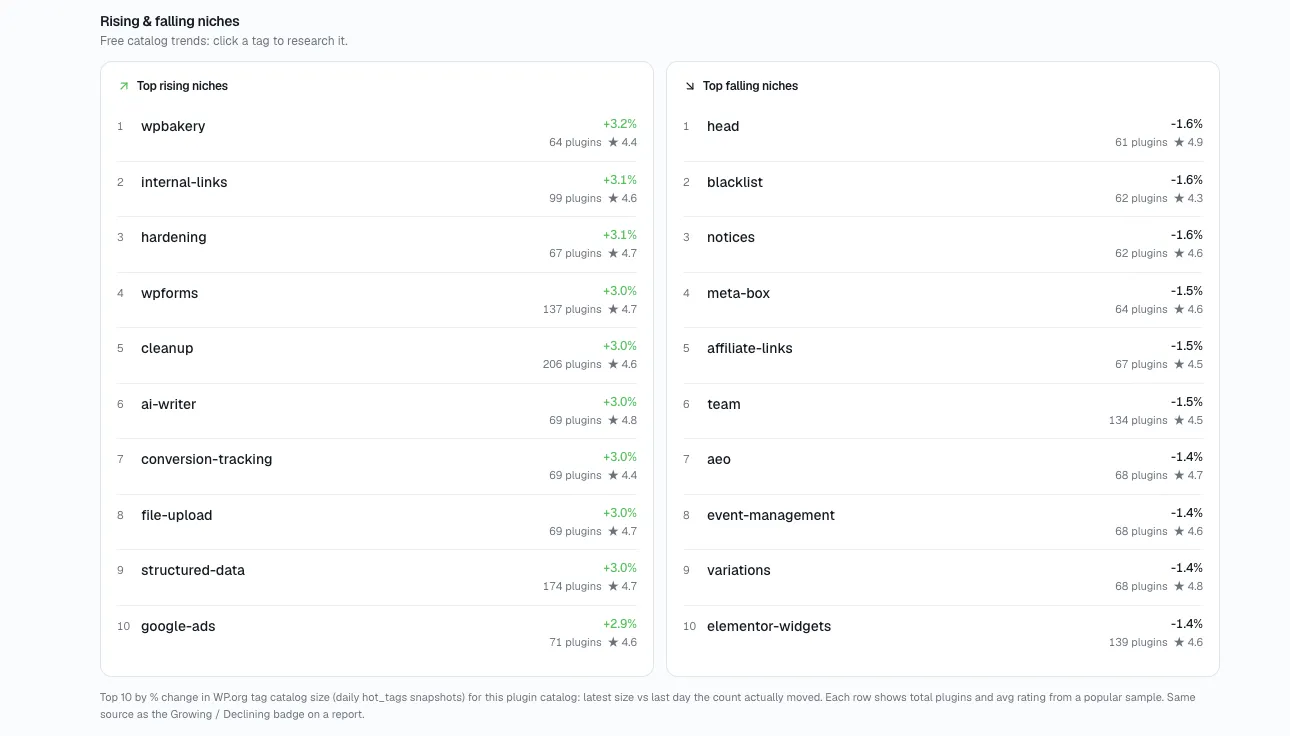
Here's the short of it: To find a rising WordPress plugin niche, check a ranked list of niches by recent install growth on a fixed monthly schedule, then cross-check anything that shows up before treating it as a real opportunity rather than a spike.
One month vs. two: a worked read
Here's what the distinction actually looks like against a hypothetical niche's monthly numbers:
| Month | Combined installs | Read at this point |
|---|---|---|
| Month 1 (baseline) | ~9,000 | Nothing notable yet |
| Month 2 (spike) | ~11,500 | Shows up on the rising list - could be a spike, could be real |
| Month 3 (confirm) | ~13,800 | Second consecutive month of growth - worth acting on |
If month 3 had instead dropped back toward 9,500, month 2 would have been a one-off - a press mention, a WordPress core change that briefly boosted one plugin's installs, or a seasonal bump that doesn't repeat. A single month of growth is a candidate; a second consecutive month is a stronger signal the growth is holding rather than a coincidence.
Why a single month can lie to you
Once a week, check a top-rising-niches list for anything you don't recognize or haven't checked recently. A niche appearing on that list once is worth noting; the same niche appearing two months in a row is worth acting on - a single month of growth can be a temporary spike from one plugin's press mention or a WordPress core change, while a second consecutive month is a stronger sign the growth is holding.
A few common causes behind a one-month-only spike worth ruling out before you get excited:
A single plugin in the niche got covered by a popular WordPress blog or YouTube channel, pulling in a burst of installs that fades once the coverage does.
A WordPress core release changed default behavior in a way that briefly pushed users toward one plugin, without reflecting any real change in underlying demand.
A seasonal pattern specific to the niche - a commerce-adjacent category spiking around a shopping season, for instance - that reverts once the season ends.
None of these are visible from the growth number alone — I've seen this hold up across a bunch of these. They only show up once you check whether month two repeats.
Check who's already grabbing that growth
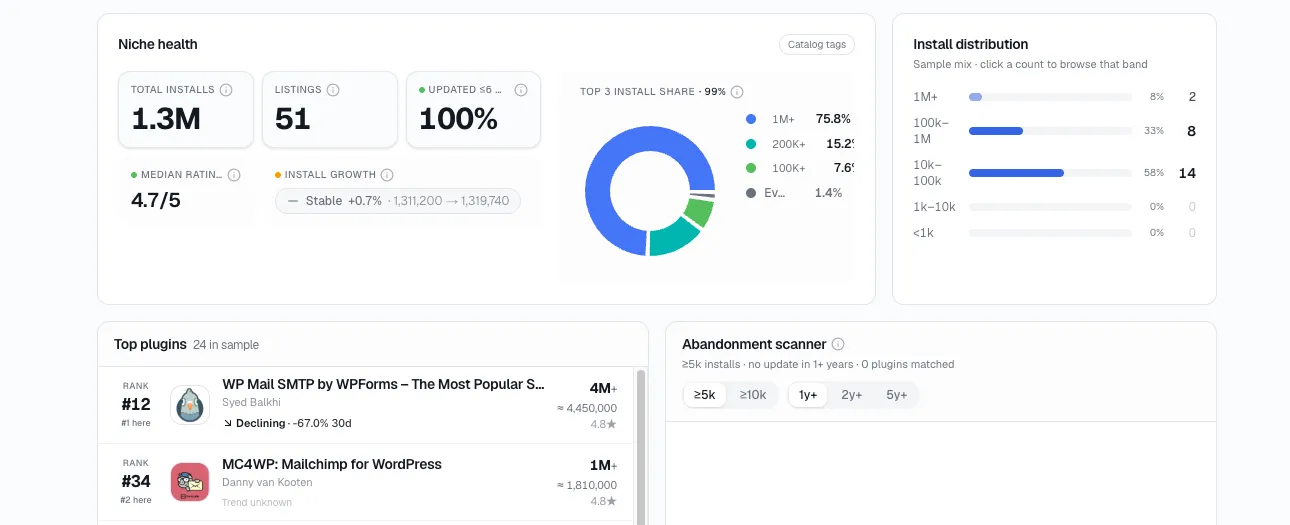
In my view, a niche showing up as rising isn't yet a validated opportunity - it's a candidate that jumped the queue. Before doing anything else, check its top-3 install concentration and maintained-listing share: rising installs concentrated in one or two plugins means the niche is growing but already has a clear leader capturing that growth, while rising installs spread across several listings is the more genuinely open version of the same signal.
Going back to the worked table earlier in this post: if the niche's month-3 growth to roughly 13,800 installs turns out to be almost entirely one plugin's gain, I'd treat that plugin as the actual story - it's already capturing the niche's momentum, and a new entrant would be competing directly against a leader that just proved it can win share fast. If the same growth is spread across five or six listings instead, the niche is growing without anyone locking it up yet, which is the more genuinely open version of a rising signal.
Give falling niches the same look
The same monthly check works in reverse. A niche that's been falling for a couple of months running is worth understanding before you rule it out entirely - sometimes a falling niche is genuinely losing relevance, and sometimes it's shrinking because its top plugin went quiet and users are actively looking for a replacement, which is a different, more useful finding than simple decline.
Not the same thing as catching a trend early
I want to be precise about which stage this habit actually catches. Spotting an emerging trend works before a niche has any real track record - a new tag, a burst of listings, a resurfacing core proposal. This monthly rising-niches check comes after that: it needs a category with enough installed history to show a month-over-month trend line at all. A trend caught by the earlier signals might not show up on a rising-niches list for months, once it has enough of a track record to register.
Run both habits, on different schedules. The early-signal read is something you watch for continuously; the rising-niches check is the fixed monthly routine that catches a niche once it's already accelerating. Between the two, a niche can be caught early, tracked as it builds a track record, and then confirmed as genuinely rising - three separate checkpoints, not one lookup repeated three times.
Let StatWP keep the list so you don't have to
Skip rebuilding this comparison by hand every month:
Open StatWP's Niche Research tool, which covers both plugin and theme niches.
Check the top rising and falling niches - they're already sorted by recent install growth, and the list updates on its own schedule instead of one you'd have to reconstruct by hand.
Once a niche has shown up rising for two months and clears the concentration check above, size it properly with the full niche-research process.
Start Your Monthly Niche Check
Rising or just noisy?
How many months of growth are actually enough to act on?
Two consecutive months is the threshold worth treating as a real signal rather than noise. Three or more is stronger still, but waiting that long risks missing the entry window on a niche that's genuinely taking off.
What counts as a "spike" versus real momentum?
A spike shows up once, then reverts toward the prior baseline the following month. Real momentum holds or keeps climbing in the second month. The worked month-by-month table earlier in this post walks through exactly that distinction using a hypothetical set of monthly numbers.
Should I check rising niches weekly or monthly?
A weekly glance at the top of the list is enough to catch anything new; treat the actual go/no-go decision - two months confirmed, concentration checked - as a monthly cadence, not a weekly one, since a single week rarely changes the read.
Does a rising niche automatically mean it's worth entering?
No - rising is one signal, not a full decision. Pair it with the top-3 install concentration and maintained-listing share check described earlier in this post, and size anything that clears both using the full niche-research process before committing to it.
What if a niche I'm watching never shows up on the rising list?
That's still useful information. A niche with genuinely flat installs month after month isn't accelerating, whatever the earlier emerging-trend signals might have suggested about it - the momentum either hasn't arrived yet or isn't coming, and the rising-niches list is how you'd actually know the difference instead of guessing.