
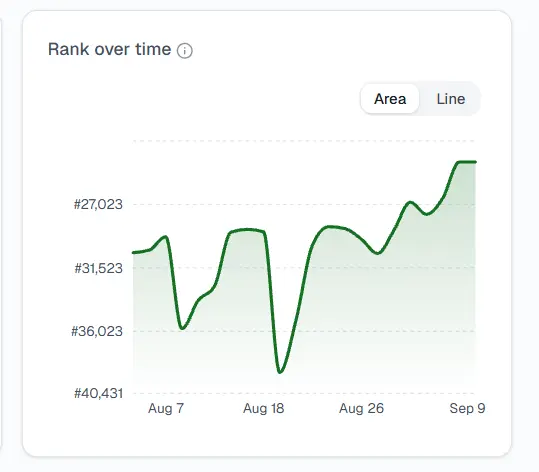
Tracking your WordPress plugin's rank over time means logging its overall standing on a fixed schedule and watching the direction, not the raw number. Rank is relative to everyone else in the directory - a rank that holds steady while the directory keeps growing around it can actually be a quiet decline that a single snapshot won't show you.
This is about your own plugin's general rank - a narrower, different thing from watching a competitor's WP.org search position for specific keywords, which is its own tracked signal for a different purpose.
Here's the deal: To track your WordPress plugin's rank over time, log its overall standing on a fixed schedule and watch the direction it's moving, not the raw number on any single day.
The number that lies to you by not moving
I've found most people assume a flat rank means nothing changed. It usually means the opposite of nothing.
The WordPress.org plugin directory keeps growing - new plugins launch continuously, and existing ones keep improving. Holding a fixed position inside a directory that's getting more crowded means you beat the average pace of everyone else just to stay put. I read a rank that hasn't moved over several months while the directory grew as a genuinely better sign than the same flat number would be in a directory that wasn't growing at all - it means you kept up with new competition, not that nothing happened.
Say your plugin sits at roughly the same rank in March and again in June. If a wave of new plugins launched into your category over that stretch, an unchanged rank means you out-paced a field that got harder to keep pace with - not that you stood still. The reverse also holds: a mild rank drop during an unusually fast burst of directory growth might just be dilution across more competitors, not a real weakening of your plugin.
What's actually pulling your rank up or down
Rank moves with several things shifting together, not with any one of them alone:
Installs. A jump in installs is the biggest single lever, but it doesn't move rank in isolation.
Ratings. A rising rating alongside an install jump moves rank more than the same install jump with flat ratings.
Support resolution. A fast-resolving support queue paired with the other two carries more weight than any of the three inputs moving on their own.
An install jump paired with flat ratings and a quiet support queue moves rank less than the same install jump paired with a rising rating and fast support responses. The way I look at it, the combination is what carries the weight, not any single input by itself.
How a quiet decline actually shows up
Here's the pattern worth watching for specifically: rank sits still for three or four months in a row, while installs also look roughly flat over the same stretch. Neither number alone looks alarming.
Read together against a directory that's still adding new plugins every month, "flat installs, flat rank" is a different situation than it looks. If the directory is growing and your rank truly hasn't moved at all, your plugin needed real growth just to hold that position - I've come to read flat installs paired with a genuinely flat rank in a growing directory as closer to a warning sign than a null result, because it suggests you're not even keeping pace with the field, let alone gaining on it.
A worked example of the trap
Say your plugin holds rank #1,240 in January and is still at #1,240 in June. On the surface, that reads as a non-event - nothing to report, nothing changed.
Now add one fact: the directory added several thousand new plugins over that same stretch, the way it does every few months as new developers publish new listings. Holding #1,240 against a directory that grew means you outran the average newcomer just to stay exactly where you were. Every plugin ranked below #1,240 that improved even slightly could have pushed you down a spot - the fact that none of them did is itself a signal to me, not an absence of one.
Flip the same logic around and the trap becomes clear: if you'd dropped to #1,300 over that stretch, it would be tempting to read that as decline. Against a directory that added thousands of new listings, dropping 60 spots might mean you barely lost ground relative to the field - a much smaller problem than the raw number suggests on its own. I don't think rank means anything until I know what it's being measured against, and "the whole directory, which keeps growing" is the context a bare number never carries with it.
Where to actually watch it
Check rank on the same monthly schedule as the rest of your growth-tracking routine, and read it alongside installs and ratings rather than on its own - rank is the signal question 4 of that monthly check is built around, and it means more read next to the other six than by itself.
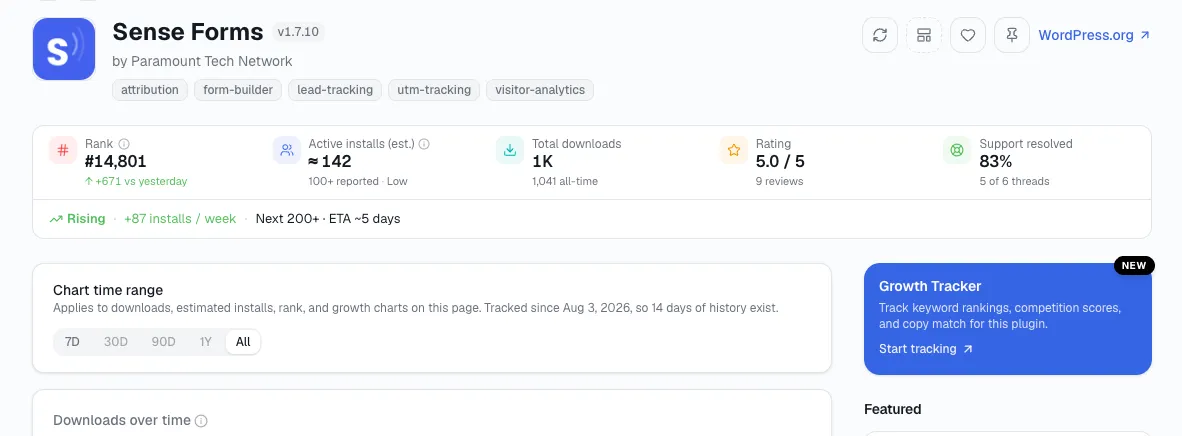
Here's where to find it: open your plugin's page on StatWP (or your theme's), search its name, and the rank-over-time chart is sitting right there already - nothing to screenshot or write down yourself.
Track Your Plugin's Rank with Growth Tracker
Rank questions worth clearing up
How often does WordPress.org actually recalculate rank? Frequently enough that day-to-day noise exists in the number - which is exactly why a fixed monthly schedule, rather than checking whenever you happen to think of it, produces a cleaner trend line than reacting to any single day's reading.
Is a rank number by itself ever useful without history? Barely, in my experience. A single snapshot tells you your position today, but not whether you're climbing, holding, or slipping - and slipping is the one a snapshot is worst at catching, since a small drop can look identical to normal noise without a trend to compare it against.
Does rank matter more than growth or installs? No - it's a tie-breaker, not the primary signal. Rank earns its place specifically when growth and momentum disagree with each other; see how to know if your plugin is growing or stalling for how the three fit together.
Can a rank climb even while active installs fall? Yes, if competitors are falling faster - rank is relative, so a plugin can gain position purely because the field around it weakened, not because it improved. That's a case worth double-checking against your own install and rating trend before assuming the climbing rank means something changed for the better on your side.
What counts as a real rank move versus normal noise? There's no fixed cutoff the way there is for install rounding, but the same discipline applies: don't act on a single month's move, especially a small one. A shift held across two or three consecutive monthly checks is a far more trustworthy basis for a conclusion than any one reading.
Keep this narrow
This post is specifically about your own plugin's (or theme's) general directory rank, tracked over time on a fixed schedule. It isn't a general guide to tracking every signal a plugin has - that's what the full monthly check is for, and it isn't about watching a specific competitor's keyword position either, which is a separate, narrower tool for a separate job.