Momentum for a WordPress plugin (or theme) means whether its growth rate is currently speeding up or slowing down - not the growth rate itself, but the rate of change built from that rate. Two plugins can report the exact same growth number this month and still be headed in opposite directions.
That distinction sounds abstract until you see it worked through with real numbers, so that's where this post starts. Where StatWP fits into reading it comes after, once the concept itself is fully landed.
Here's the fast answer: WordPress plugin momentum means whether growth is speeding up or slowing down right now, not the growth rate itself - two plugins can post the same growth number this month and still be headed in opposite directions.
Growth is a speed. Momentum is whether you're pressing the accelerator or the brake.
Growth answers "how fast am I moving right now." Momentum answers a different question: "am I speeding up or slowing down." A car doing 60 mph tells you nothing about whether the driver has their foot on the gas or the brake - you need the reading from a moment ago to know that.
Three plugins, all growing this month, tell three different stories once you look at last month too:
Flat momentum. Growing installs by 5% this month and 5% last month. Steady, unremarkable - the rate itself hasn't changed.
Strongly positive momentum. Growing 5% this month after 2% last month. The rate itself nearly tripled, even though the raw growth number might still be smaller than a competitor's flat 8%.
Negative momentum. Growing 5% this month after 9% last month. Still growing, but the rate has nearly halved - it's slowing down into what will likely be a flat or negative month soon if the pattern continues.
All three plugins can show up on a dashboard as "+5% this month." I'd only call one of them actually in good shape once you check what came before it.
What actually moves momentum
My usual take: momentum shifts don't happen for no reason - something usually triggers the rate of change itself changing, not just the raw growth number. A few common triggers, in roughly the order they show up in practice:
A release. A well-received update can accelerate momentum for a month or two as word spreads; a buggy one can decelerate it just as fast.
A WordPress core update. A compatibility break after a core release can flatten momentum industry-wide for plugins in the affected category, not just yours.
A competitor's launch or acquisition. New alternatives pulling from the same install base show up as decelerating momentum before they show up as negative growth.
Seasonal patterns. Some categories - ecommerce plugins around shopping seasons, event plugins around conference calendars - have momentum that predictably builds and fades on a yearly cycle, independent of anything you did.
A short glossary, since these terms get mixed up
Three terms do different jobs here, and it's easy to blur them together:
Growth rate. How much your installs changed this month, usually as a percentage. A single-month snapshot.
Momentum. Whether this month's growth rate is higher or lower than last month's. Built from two growth-rate readings, not one.
Acceleration / deceleration. Plain-language names for positive and negative momentum - momentum "building" means accelerating, momentum "fading" means decelerating.
I don't act on a small momentum shift - a growth rate moving from 5% to 4.5%, say - by itself; it can just be normal month-to-month noise, and it runs into the same rounding-cutoff issue that affects any single month's install count. A shift of several points in either direction, especially held over two or more months, is the one worth actually paying attention to.
What ignoring momentum actually costs you
Picture a plugin author who checks one number a month: total growth. For most of a year, that number stays positive - 6%, then 5%, then 4%, then 3% - so every monthly check ends the same way: "still growing, nothing to do here."
Looked at as momentum instead of growth, the same run of months tells a different story - the rate has been shrinking every single month, without one exception. I'd have flagged the slowdown around month three or four just from tracking momentum. The growth-only reader doesn't notice anything is wrong until the number finally goes negative, months after the pattern was already visible.
That gap - between when momentum shows a problem and when growth confirms it - is exactly why I track momentum as its own thing instead of assuming growth alone tells the full story.
See it as a single field instead of doing the subtraction yourself
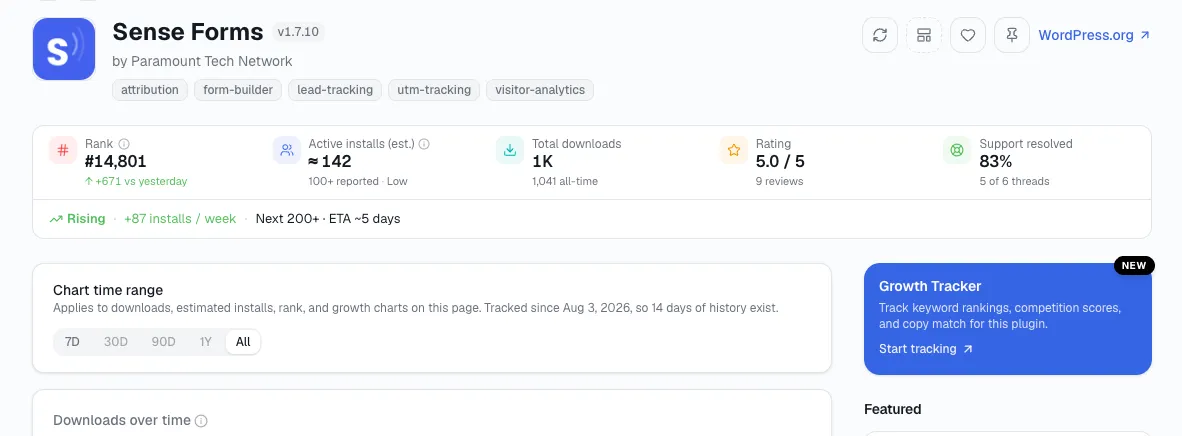
Once you understand what momentum is measuring, checking it for your own plugin doesn't require pulling two months of numbers and doing the subtraction by hand. Open your plugin's page on StatWP (or your theme's) and search its name - momentum is reported directly as a one-word verdict sitting next to the growth figure, for any plugin or theme, not just your own.
Common questions about momentum
Can momentum be positive while growth is negative? Yes - that's the recovery case. A plugin losing installs more slowly than it did last month has improving momentum despite still-negative growth, and it's often the first sign a decline is turning around.
Does a single month of fading momentum mean something is actually wrong? Not on its own, in my experience. One month close to a rounding cutoff can shift momentum's reading without anything real changing underneath it. Two consecutive months moving the same way is a much stronger basis for a conclusion.
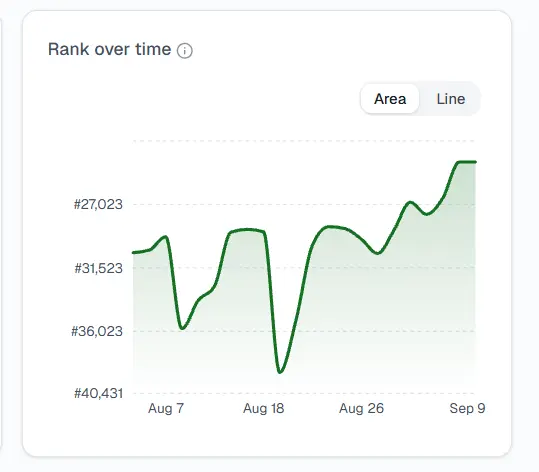
Is momentum the same thing as rank? No. Momentum describes your own plugin's growth rate against its own past. Rank describes your plugin's position against every other plugin in the directory - a different signal, useful as a tie-breaker when growth and momentum disagree.
How many months of data do I need before momentum means anything? Technically two - this month's growth rate and last month's. Three or more consecutive readings make the pattern much more trustworthy, since a single pair of months can still be skewed by one unusual event, like a release, a directory feature, or a rounding-cutoff crossing.
Momentum doesn't tell you why - just that something changed
I place momentum under symptom-level signal, not diagnosis. Fading momentum tells you the growth rate is dropping; it doesn't tell you whether that's a competitor launching, a WordPress core change breaking compatibility, a stalled release cycle, or plain seasonal variation.
Treat a momentum shift as the cue to go look for a cause, not as the finding itself. Line the month momentum changed up against your own release dates and anything you know happened in your plugin's category - the "release activity" question in the wider monthly check exists for exactly this reason.
Fold it into the bigger routine
Momentum is one of the seven questions in the monthly growth-tracking check, and it's most useful read directly alongside growth itself - combining the two into one verdict is what actually tells you whether you're growing, stalling, or somewhere in between that a single number wouldn't show. Rank comes in as the tie-breaker when growth and momentum disagree - see how to track WordPress plugin rankings over time for reading that signal on its own.