
"Terrible plugin, don't waste your time" is a complete WordPress.org review, and it tells you almost nothing. No error message, no plugin version, no theme name — just a verdict.
Most critical reviews sit somewhere between that and a proper bug report. If you're reading a plugin's (or a theme's) reviews as research — sizing it up as a competitor, or checking whether a niche has room for something better — this is the close-reading skill that turns the vague ones into an actual idea worth testing.
In short: To find the real complaint hiding in a vague 1-star WordPress plugin review, close-read it for the specific situation behind the venting instead of taking the star rating at face value.
Why a One-Line Rant Isn't a Dead End
A vague negative review still carries information — it's just compressed. "Don't waste your time" is what someone writes when they hit a wall early enough that they never got attached to the plugin, and frustrated enough that they wanted to warn other people off. I read that as a data point about severity and timing, even without a single technical detail.
The mistake is treating a vague review as unusable and skipping straight to the reviews that already explain themselves. The vague ones are often the majority, and ignoring them means judging a plugin's problems from a biased sample — only the reviewers patient enough to write a full paragraph.
Don't Stop at 1-Star — the 4-Star Reviews Carry Real Signal Too
It's tempting to only read the 1-star pile, since that's where the loudest complaints live. But a 4-star review is often the highest-signal complaint in the whole set. A reviewer who gives four stars still likes the plugin enough to almost recommend it — "great plugin, but I wish it did X" is close to a feature request written by an actual paying user, not a rage post from someone who bounced off the setup screen.
Reading the full 1- to 4-star range, not just the 1-star pile, is what turns this from "here's what people hate" into "here's what would make people love it."
Translate the Venting Into a Question You Can Test
The fastest way to get value out of a vague review is to convert the emotional language into a specific, checkable question. The wording is a clue about the category of problem, even before you know the exact cause.
| What the review says | What it's usually signaling | What to check next |
|---|---|---|
| "Broke my site" | A fatal error, white screen, or conflict on activation | Does the reviewer mention a theme, another plugin, or PHP version anywhere in the review or their reply history? |
| "Doesn't work at all" | Either total malfunction or a feature the reviewer expected but the plugin doesn't have | Is there a setting or requirement the plugin's own listing already states as a prerequisite? |
| "Support never responded" | A process complaint, not a functionality complaint | Is this reviewer also describing a technical issue, or is the review entirely about response time? |
| "Great, but wish it had X" | A specific, named feature gap from someone who otherwise likes the plugin | Does more than one reviewer name the same missing feature, independently? |
| "Confusing, gave up" | A usability problem, not necessarily a bug | Is there a specific step or screen named, or is the whole setup flow the issue? |
Here's what I've come to believe: none of these translations are guaranteed to be right for any single review — they're a starting hypothesis. The point of the table is to stop treating "terrible plugin" as a dead end and start treating it as a category to test against the rest of the evidence.
Read the Reviewer, Not Just the Review
A single review is thin evidence on its own. Two things widen it without much extra effort:
- Check if the reviewer left other reviews. Someone who reviews a lot of plugins tends to write in a consistent style — if their other reviews are all similarly short and blunt, the brevity here is just how they write, not a special signal about this particular plugin.
- Check the version and date. A vague complaint posted the same week as a release is worth weighing differently than the same complaint posted two years ago — see how to tell if a complaint pattern is new or ongoing for how to use that timing.
Where the Complaint Topics Come From Before You Close-Read Them
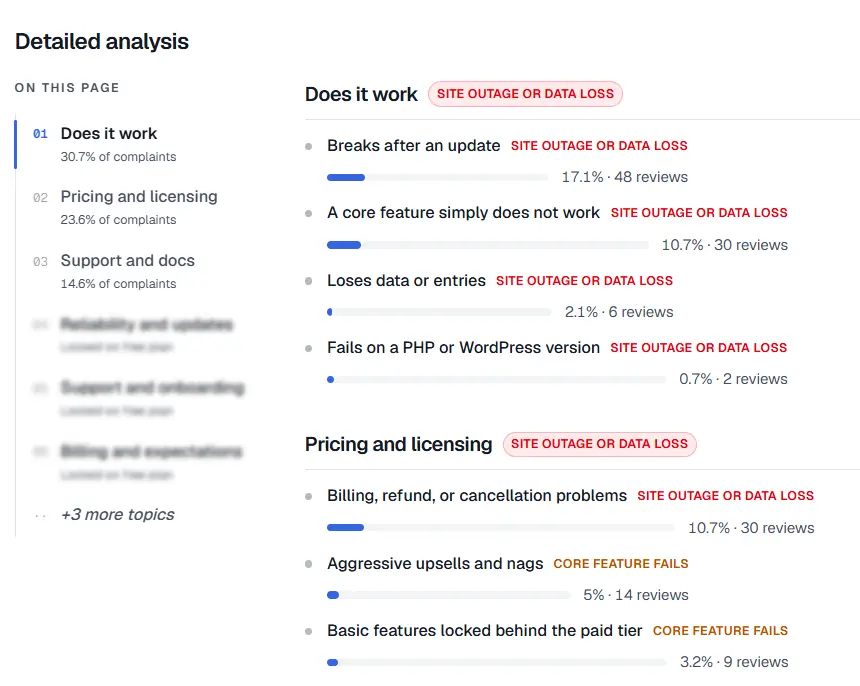
Complaint topics broken into named sub-issues before you go close-read the vague ones.
Close-reading works review by review, which is fine for the handful of reviews that already look important. It doesn't scale to deciding which reviews are worth that attention in the first place, out of a hundred or more spread across the full 1- to 4-star range.
That's the part StatWP's Review Gap Finder handles first: it groups a plugin's (or a theme's) reviews into complaint topics using AI and ranks them by severity, so you know which cluster of vague-sounding reviews is actually the biggest, most severe pattern before you spend time reading any of them individually. The close-reading method above is what you apply once you're inside a cluster, not a replacement for it — the grouping tells you where to look, the reading tells you what's actually there.
See the Complaint Clusters Yourself
A Hypothetical Walkthrough
To make the translation table concrete — this example is illustrative only, not a real observed pattern for any specific plugin. Say you're researching a plugin in a niche you're considering entering, and its critical and mid-tier reviews cluster into three loose groups once you start reading past the star ratings: several reviews mentioning a blank screen right after activation, several 4-star reviews wishing the settings page did more, and a couple about slow support replies.
Reading the first group closely, three of five reviews turn out to name the same third-party caching plugin. In my read, that's no longer "broke my site" — it's a specific, testable compatibility issue, and not necessarily a reason to avoid the space. The second group, on closer read, turns out to be reviewers who like the plugin but keep asking for the same specific export option — a concrete, named feature gap. The third group is a process issue with no product fix at all. Same three vague-sounding complaint types, three completely different takeaways — and none of that distinction was visible from the star ratings alone.
How Many Reviews Before a Pattern Is Real
Close-reading a single vague review is useful, but a single review is still a sample of one. Before treating a translated hypothesis as an actual idea worth pursuing, check whether more than one reviewer is describing the same thing in their own words.
I use two or three reviews using different phrasing to describe what sounds like the same underlying issue as a reasonable threshold to start treating it as a real pattern rather than one person's specific bad luck. I've noticed this repeat itself: a single outlier review, however dramatic the wording, is weaker evidence on its own — worth noting, not worth building anything around until something else corroborates it.
This is also where volume works against manual reading. It's easy to notice that three vague one-liners share a theme when they're the only three critical reviews a plugin has. It gets much harder once there are two hundred reviews spread across several years, which is exactly the situation where a first-pass grouping tool earns its keep — before the close-reading described above ever starts. Prioritizing which patterns are actually worth building a feature for is the step that comes after you've confirmed a pattern is real.
Frequently Asked Questions
Is it worth close-reading a review that's only one sentence long?
Yes, if it belongs to a cluster of similar short reviews — the pattern across several one-sentence reviews is often clearer than any single one of them. I put a single one-sentence outlier with no similar reviews around it lower on the priority list to chase down.
What if two reviews use the same vague phrase but seem to mean different things?
I set this phrase down as a starting hypothesis, not a fixed category — the translation table is a way to generate a guess quickly, and the guess needs checking against whatever other detail the review or reviewer history provides.
Should I only read 1-star reviews if I'm short on time?
No — at minimum skim the 4-star reviews too. They're where "almost loved it, except for X" complaints live, and those are often the clearest feature ideas in the whole set, since they come from people who nearly became fans.
How does this connect to figuring out whether a complaint is a real product gap?
Close-reading gets you to a specific, testable claim. The next question — whether that claim is really a gap in the product or a conflict from the reviewer's own setup — is a separate check, covered in how to tell if a plugin complaint is a real gap or just a setup problem.
Reading past the frustration is a habit, not a one-time exercise — worth doing for every new cluster of reviews, not just the current batch. For the fuller workflow this fits into, start with how to turn a plugin's bad reviews into your next feature idea.