
Your competitor's negative reviews are sitting in public on WordPress.org right now, and most of them never get read past the star count. That's a gap — a competitor's complaint pattern tells you exactly where their product is losing people, which is exactly the information you need before deciding what to build next.
This is the single most common way people actually use StatWP's Review Gap Finder — not to audit their own plugin, but to read a competitor's reviews for real product gaps. This post is specifically about reading a competitor's negative reviews for complaint patterns — a narrower, deeper cut than the broader competitor-research posts on this site, which treat reviews as one signal among several.
Here's the takeaway: To see what reviewers complain about in a competitor's WordPress plugin, read their negative WordPress.org reviews for the complaint pattern - most people never look past the star count, which is exactly the gap worth exploiting.
Reviews Are One Signal Among Several — This Post Covers Just That One
StatWP already has posts on the broader work of sizing up a competitor: finding a competitor's strengths and weaknesses and reverse-engineering a successful WordPress plugin. Both touch on reviews as part of a wider picture that also includes install trends, feature sets, and pricing.
This post goes deeper on exactly one of those signals: what a competitor's own reviewers say is wrong with their plugin. If those two posts are the wide-angle view, this is the zoom lens on one part of it.
Why a Competitor's Complaints Are Worth Reading Closely
A competitor's negative reviews are a list of problems someone else has already validated as real and worth complaining about publicly — you didn't have to run a survey or guess. Three things that pattern can tell you:
- A specific gap you could fill. If a competitor's users repeatedly complain about a missing feature or a clunky flow, that's a concrete, evidence-backed argument for building it — or building it better.
- A category-wide problem, not a competitor-specific one. Sometimes a complaint is really about a constraint every plugin in that space runs into (a WordPress core limitation, a common hosting quirk). Knowing that in advance stops you from promising a fix you can't actually deliver either.
- Where their support or documentation is failing. I've found a cluster of confused-setup complaints often points at a documentation gap more than a product gap — useful to know if your own onboarding can cover the same ground better.
How to Run This Analysis on a Plugin You Don't Own
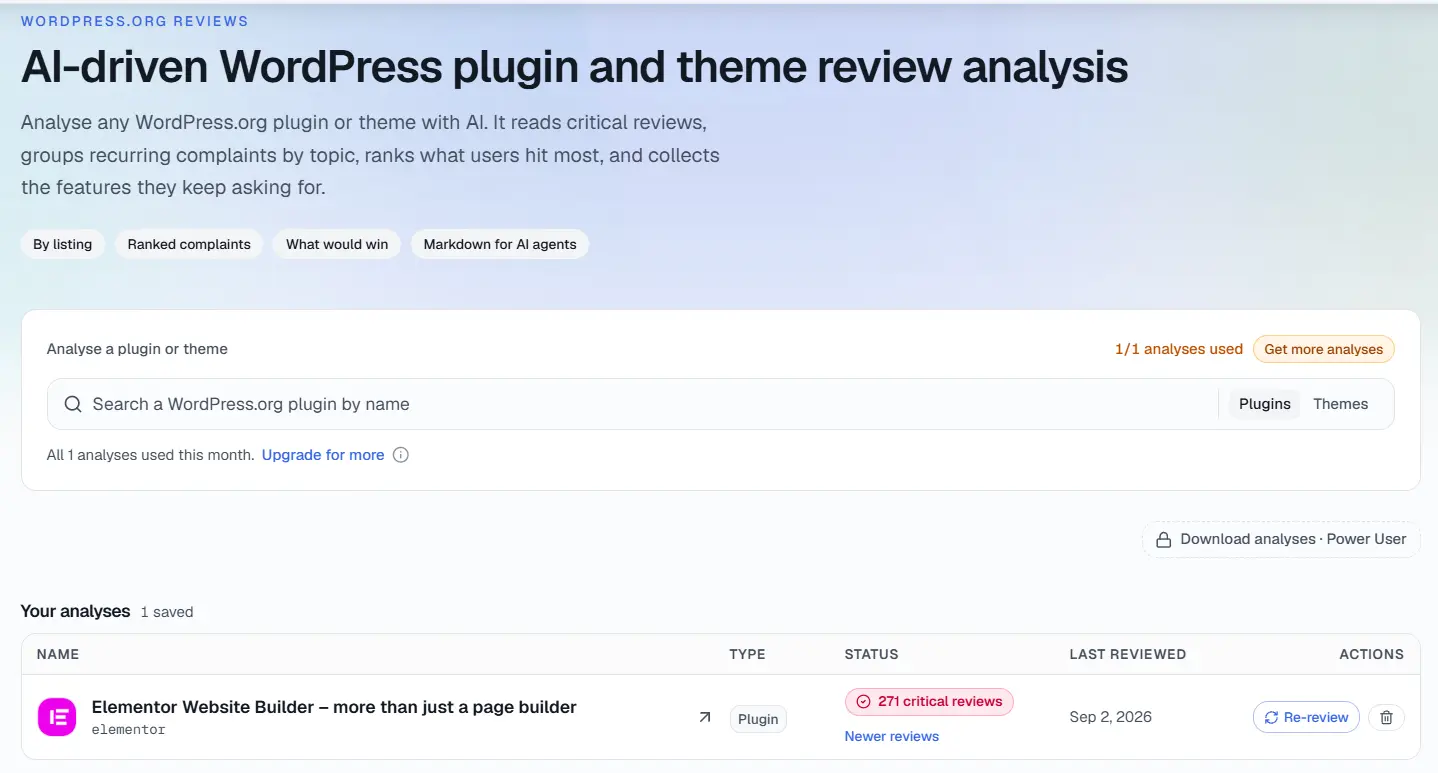
Pointing Review Gap Finder at a competitor's plugin works the same way as running it on your own.
Nothing about complaint clustering requires that the plugin be yours — a WordPress.org plugin's reviews are public, and the same grouping process applies to any plugin's (or theme's) review history. This is the default way to use Review Gap Finder, not a special case:
- Pull the competitor's full 1- to 4-star review range, not just the worst-rated reviews.
- Group them into complaint topics and rank them by severity — StatWP's Review Gap Finder does this the same way for any plugin, since the underlying grouping is AI reading and clustering review text, not something specific to plugins on your own account.
- Read the top clusters closely, translating vague language into a specific, checkable claim.
- Sort what you find into "gap I could fill" versus "shared limitation everyone in this space has," then weigh what's actually worth building.
Analyze a Competitor's Reviews Now
What to Look For: a Real Gap vs. Shared Pain
Not every competitor complaint is an opportunity. The useful split is between a complaint that's specific to how that plugin built something, and a complaint that's really about the whole category.
| Signal | Likely a real gap you could fill | Likely shared category pain |
|---|---|---|
| Wording | Names a specific missing setting, a specific clunky screen, or "wish it could do X" | Describes a limitation phrased as inherent — "WordPress just can't do this well," "every plugin like this has this problem" |
| Comparison mentions | Reviewer names a different plugin that handles it better | No comparison offered — just a flat statement of the limitation |
| Consistency | Shows up for this competitor specifically, not for other plugins in the same space | Shows up across multiple competitors' reviews when you check more than one |
A Hypothetical Example
This is illustrative only, not real observed data about any named plugin. Say a competitor's complaint clusters turn up two patterns: one group of reviewers frustrated that a specific report only exports as a screenshot, not a spreadsheet — a specific, fixable product gap — and a second group frustrated that a feature is locked behind a much more expensive plan than they expected. I'd call the first a genuine opening: build the export feature well and you have a concrete talking point. The second, in my view, is more about that competitor's pricing structure than their product — worth noting, but not something you fix by building anything.
Where This Fits With the Rest of Competitor Intelligence
Use this post as a companion pass alongside finding a competitor's strengths and weaknesses and reverse-engineering a successful plugin, not a replacement for either. Those posts tell you what a competitor is doing right and where they're structurally exposed across the full picture — installs, growth, pricing, features. This post hands you one specific, deep input to feed into that picture: what their own users say is broken.
How Often to Repeat This
A competitor's complaint pattern isn't static — it shifts as they ship releases, and a gap you noted six months ago might already be closed. Also worth checking again: whether a complaint you flagged as fresh has since turned chronic and unaddressed, which makes it a stronger opportunity than it looked at first glance.
I re-check a key competitor's complaint clusters after any release I notice from them, or on the same schedule I already use for checking their install and ranking numbers — folding it into an existing competitor-tracking habit is easier than remembering to run it separately.
Frequently Asked Questions
Is it fair to read a competitor's reviews for product ideas?
Reading a competitor's public reviews for product ideas is the same information any WordPress.org visitor can already read — you're not accessing anything private. Using a public signal to inform what you build is standard competitive research, not something to feel uneasy about.
Should I mention a competitor's known complaints in my own plugin's marketing?
Naming a specific competitor's flaws in public marketing can read as a cheap shot even when accurate, so I'd be careful here. A competitor's complaint pattern is far more useful as private research that shapes what you build than as a direct comparison claim.
What if a competitor has very few negative reviews?
A thin negative review count from a competitor is informative in itself — I've bumped into this a few times before — it might mean genuinely few problems, or it might mean low review volume overall rather than low complaint rate. Check their total review count before reading too much into a small number of critical ones.
How is this different from just checking a competitor's star rating?
I don't put much weight in a star rating alone — it's a single number with no detail behind it. Two plugins can carry the same average rating for completely different reasons; reading the actual complaint clusters is what tells you which specific problems are dragging the number down.
Is this the main way people use Review Gap Finder?
Yes — pointing StatWP's Review Gap Finder at a competitor's plugin (or theme) is the tool's primary use case. Running it on your own plugin's reviews is a valid secondary use, but it's not what most people reach for it to do first.
A competitor's complaint pattern is public, specific, and free to read — worth the deeper look, on top of the broader competitor-research work covered elsewhere on this site. For the full review-analysis workflow this deep dive plugs into, see how to turn a plugin's bad reviews into your next feature idea.