
Spotting an emerging WordPress plugin trend means catching one of four early signals before a niche is even a niche yet - a brand-new tag appearing, a burst of new listings landing in a short window, a WordPress core proposal that won't stay buried, or the same specific request clustering across unrelated plugins' support forums.
This is the earliest possible stage, before there's a recognized category to rank or measure. Once a trend has actually become a niche with a track record, tracking its momentum is a different, later-stage habit - covered in finding rising WordPress plugin niches. This post is about what counts as a signal in the first place, before that.
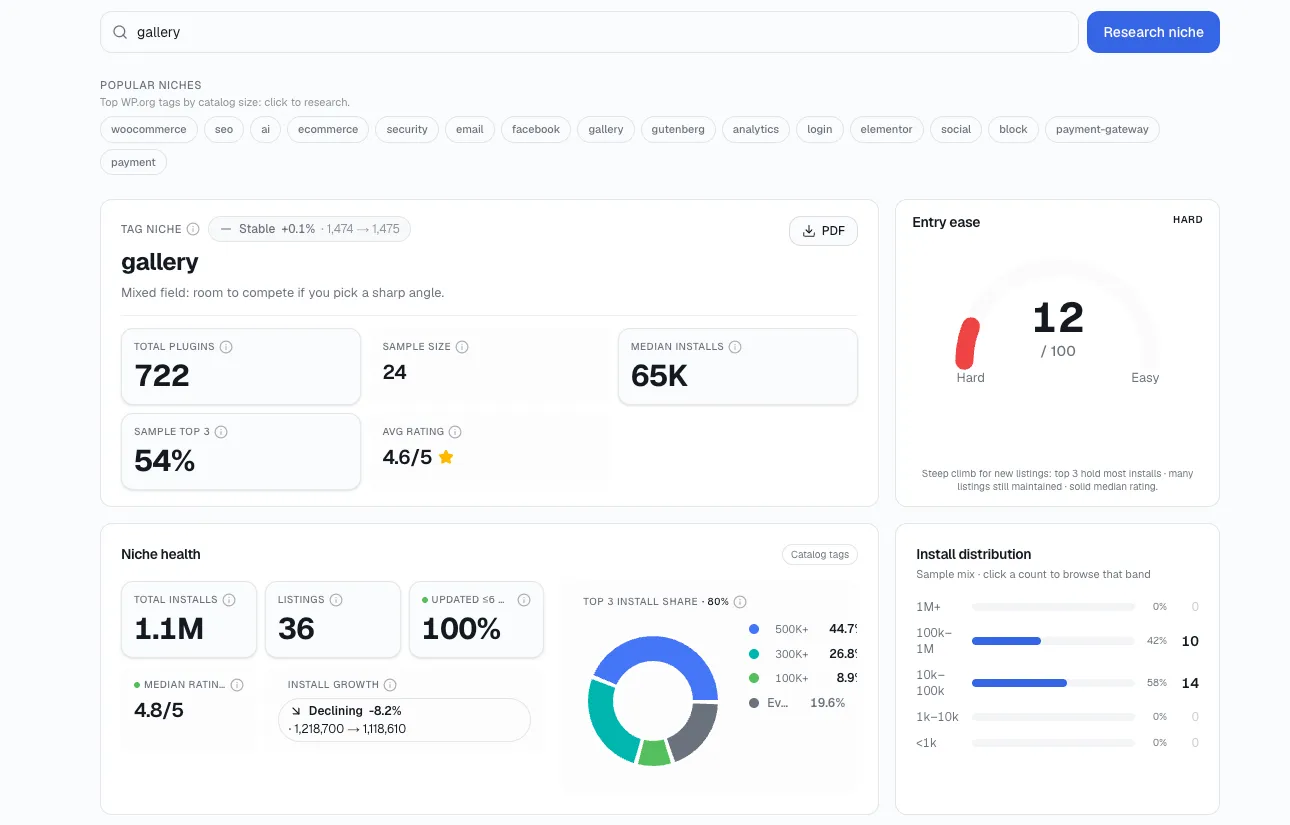
Straight answer: You spot an emerging WordPress plugin trend by watching four early signals - a new tag appearing, a burst of new listings, a WordPress core proposal that won't go away, or the same request repeating across unrelated plugins' support forums - before the trend is even a recognized niche.
Four signals, and how much weight to give each
I don't treat any of these as proof by themselves - they're reasons to look closer. Some are stronger on their own than others, and a signal that shows up alongside a second one is worth far more attention than either alone:
Signal 1: a tag that didn't exist before shows up
A genuinely new tag appearing across a handful of listings - not a rename of an existing one, an actual new term nobody was tagging plugins with before - is one of the earliest signals available, because it means plugin authors themselves are inventing new language for a capability that didn't have a name yet. From what I've tracked, it's also the weakest signal used alone: a new tag can just as easily reflect one author's idiosyncratic labeling as a real category forming.
Signal 2: a burst of new listings lands in a short window
Several new plugins launching into the same thin tag within a few months is a stronger version of the same idea. A tag that jumps from a handful of listings to several times that over a short period is a meaningfully different signal than a large, mature tag adding the same raw number of new listings - the growth rate relative to the existing base is what matters, not the absolute count. A large tag adding ten listings might not move its growth rate at all; a small one adding ten listings could be tripling in size.
Signal 3: a core proposal that won't stay buried
WordPress core regularly discusses features that don't make it into a release. A proposal that gets deferred once and never mentioned again is probably genuinely low-demand. One that resurfaces across multiple release cycles, each time with renewed discussion, is a signal that the underlying need is real even though core hasn't taken it on - which is exactly the kind of need a plugin ends up solving instead.
Signal 4: the same request, showing up in unrelated places
One user asking for a specific capability in one plugin's support forum is a single data point. The same specific request appearing in the support forums of two or three otherwise unrelated plugins, in roughly the same period, is a pattern - it suggests something changed in how people are using WordPress broadly, not just a preference of one plugin's particular user base.
Why signal strength isn't the same across all four
I think of the four as a ladder, not a checklist where every item counts equally. A new tag alone is weak evidence - tag creation is easy and cheap, so plenty of new tags never turn into anything. A listing burst is stronger, because it means multiple independent authors made the same bet within the same window, which is harder to fake by accident. A resurfacing core proposal and cross-plugin forum clustering are both demand-side signals rather than supply-side ones - they say people want something, independent of whether anyone's built it yet, which makes them the more durable of the four when you're trying to get ahead of a trend rather than just noticing one already forming.
The strongest position, in my experience, is two signals at once: a demand-side signal (a recurring core proposal, or forum clustering) lining up with a supply-side signal (a new tag or listing burst) in the same rough window. That combination means both the need and the first attempts to meet it are showing up together, which is close to the earliest a trend can be caught with any real confidence.
Not the same thing as a rising niche
It's easy to confuse this with tracking momentum, and the two are genuinely different stages. Finding rising niches works off a niche that's already recognizable - it has a track record of combined installs you can measure month over month, and the question is whether that established category is accelerating. The four signals here apply before any of that exists: before there's a track record, sometimes before there's even a settled name for the category. A trend that clears one of these four signals today might not become a measurable, rankable niche for months.
Turning a signal into a candidate
Once a signal holds up - especially two of them lining up together - I'd call the tag or category it points to a candidate. A quick way to screen it next is checking whether it already shows room to grow, and from there run it through the full niche-sizing process once it has enough of a track record to measure.
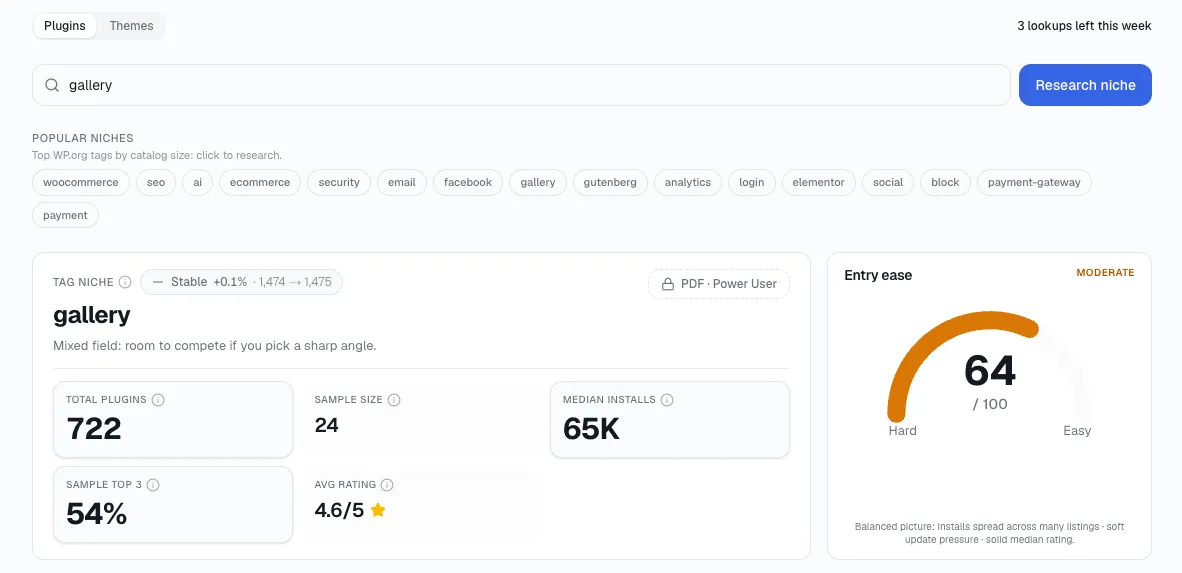
StatWP's Niche Research tool tracks tag-level listing growth directly, which is the fastest way to actually catch signals one and two before they're obvious to everyone else - open it, search a plugin or theme category you're watching, and check whether its listing count is climbing off a small base rather than waiting to notice the pattern by memory.
Reading the signal right
How early is "early," really?
Early enough that the category might not have a track record yet - no reliable month-over-month install trend to check. That's the whole point of these four signals: they're readable before there's enough history for a momentum-based check like a rising-niches list to catch anything.
What if I only ever see one signal, never two together?
A single signal is still worth noting, in my experience, just don't act on it alone. I watch it for a few weeks - a real trend usually produces a second signal not long after the first, since demand-side and supply-side pressure tend to build together once something is genuinely forming.
Can a signal turn out to be a false alarm?
Yes, regularly. A new tag can be one author's personal naming choice, a listing burst can be a handful of near-identical clones rather than genuine independent demand, and a core proposal can resurface for years without ever reflecting real plugin-level demand. I weigh all four as leads to verify, not conclusions.
Does StatWP flag these signals automatically?
StatWP's Niche Research tool surfaces tag-level listing counts and growth directly for plugins and themes alike, which is where signals one and two show up first - it doesn't label something "emerging" for you, but it's the fastest way to check a specific tag's growth rate against its base once you already suspect something's forming.